An LED mirror with a defogger is a bathroom mirror that combines integrated LED lighting with a heated pad behind the glass. That pad clears steam within 60–90 seconds of switching on, so you get a crystal-clear reflection after even the hottest shower. Below: how the technology actually works, when you genuinely need it, wattage and coverage rules of thumb, safety ratings decoded, and a copy-paste buying checklist tuned for Indian bathrooms.
What a defogger LED mirror actually is
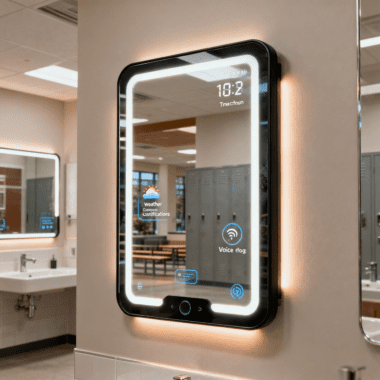
Two independent circuits sit behind the same piece of silvered glass. The LED perimeter provides illumination — usually a 3000K, 4000K, or tunable 3-colour strip diffused through a light channel. The defogger pad (a thin PET heating film, similar in principle to a car rear-window defroster) sits against the back of the mirror in the zone your face will typically occupy. When you touch the sensor, both circuits energise and the pad warms the glass by roughly 5–10°C, preventing water vapour from condensing on the surface.
How the heating film works
The pad is a screen-printed conductive ink on a polyester substrate. Electricity flows across the ink and produces gentle, evenly-distributed heat via ohmic resistance. Because the pad is heat-conductive but electrically bonded behind the silver backing, there is no risk of short circuit even if the mirror gets soaked. All good units run on 12V DC or 24V DC through an external driver, so the pad itself never carries mains voltage.
Do you actually need a defogger?
Yes, if:
- Your bathroom lacks an exhaust fan or a window that opens
- You take hot showers regularly (India’s coastal humidity + geyser water = heavy steam)
- The mirror is directly opposite or adjacent to the shower area
- You need to shave, apply makeup, or use skincare products immediately after showering
- It’s a hotel, guesthouse, or serviced apartment where guests expect a clear morning-after mirror
You can skip it, if:
- The bathroom has good cross-ventilation or an active exhaust
- The mirror is more than about 2 metres from the shower
- It’s a powder room or half-bath with no shower
- You typically use the mirror only for a quick check on the way out
Reading the spec sheet: wattage vs bathroom size
Defogger pad wattage should be sized to the mirror surface area — typically 4–6W per square foot. A 60×80 cm mirror needs a 25–35W defogger. Bigger vanities may combine two pads. Ask the seller for the pad size relative to the mirror — an undersized pad will only clear the centre of the mirror and leave a fogged ring around the edge.
Warm-up time is a proxy for pad quality. 60–90 seconds is the industry norm for a well-designed unit. If a spec sheet claims 30 seconds, the pad is likely oversized and drawing 8W+ per square foot — you’ll feel a warm spot on the mirror and it will shorten LED lifespan.
Safety ratings decoded: IP44 vs IP54
All LED mirrors sold for bathroom use in India should be at least IP44. The two digits describe protection against solids and against water.
- IP44: protected against water splashes from any direction. Sufficient for wall-mounted mirrors installed away from direct shower spray.
- IP54: adds dust protection and low-pressure water jets. Better if the mirror is close to the shower or in an outdoor-adjacent vanity.
Anything below IP44 — or unrated — is not safe for Indian bathroom humidity and should be avoided regardless of price.
Installation and power
All LED mirrors we manufacture run on 12V DC or 24V DC. A driver (external transformer) converts your 220V AC concealed wall point down to the safe low voltage. The driver typically hides inside a wooden vanity cabinet or in a service ceiling. No special conduit is required — any qualified electrician can install one in 30–45 minutes. What matters:
- The wall point must be behind the mirror or within 30cm of it
- The driver must sit somewhere ventilated — do not seal it inside a closed cavity
- The mirror’s hanging bracket must be anchored into a wooden frame or with drywall anchors rated for 15kg+
How much power does a defogger LED mirror actually draw?
A typical 60×80 cm mirror draws roughly 20W for LED + 30W for defogger = 50W total when both are running. If you run everything for 15 minutes per day, that’s about 4.5 kWh per year. At Indian tariffs (~₹8/unit residential), the mirror costs less than ₹40 per year to operate. Skip the “energy efficient” marketing anxiety — LED mirror running cost is negligible.
Lifespan and warranty
LEDs on a well-built mirror last 50,000–70,000 hours. At 30 minutes per day, that’s over 15 years. What typically fails first: the touch sensor (5–8 years), the defogger pad (7–10 years), then finally the LEDs. That’s why we offer a 5-year LED warranty as standard — the failure curve for LEDs starts flattening well beyond that window.
Buying checklist
- Is the defogger pad sized for the full mirror surface (4–6W per sq. ft)?
- Is the entire unit rated at least IP44?
- Does it include an external 12V or 24V driver from a reputable brand?
- Are the LEDs branded (Syska, Philips, Osram) rather than generic?
- Does the seller warranty the LEDs for at least 5 years?
- Is the mirror silvered with copper-free, corrosion-resistant backing (Belgium or Saint-Gobain glass ideal)?
- Does the touch sensor sit under the glass (not a pushbutton on the frame)?
- Does the manufacturer offer custom sizes if your bathroom needs a non-standard fit?
- Is the driver installation location documented in the manual?
- Are dimming and 3-colour options available if you want them?
Frequently asked questions
Does a defogger LED mirror need a special electrical connection?
No. It runs on a standard 220V AC concealed point behind the mirror, stepped down to 12V or 24V DC through an included driver. Any qualified electrician can install one in 30–45 minutes.
Is defogger the same as anti-fog coating?
No. Anti-fog coatings are hydrophilic chemical films that spread water into a thin invisible layer. They fade in 6–12 months and cannot be reapplied on a mirror. A defogger LED mirror uses active heat and lasts as long as the electronics.
How much power does the defogger draw?
Roughly 25–35W for a standard 60×80 cm mirror. Even at 30 minutes per day, that’s under ₹15 per month in electricity.
Can I install a defogger LED mirror myself?
The mounting itself is straightforward but you should have a qualified electrician handle the mains-to-driver connection. Improper wiring can trip your bathroom RCCB or, worse, invalidate warranty.
What is the difference between IP44 and IP54?
Both prevent water splashes. IP54 adds dust protection and slightly better resistance to direct water spray, useful if the mirror is near the shower zone. IP44 is sufficient for a normal wall-mounted vanity mirror.
Shop defogger LED mirrors from LEDMirror.in
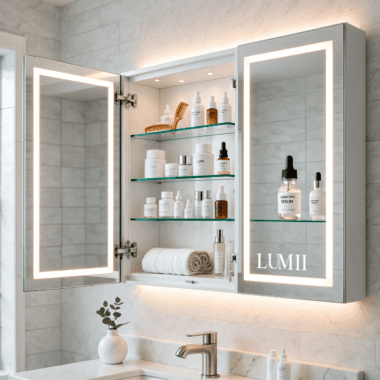
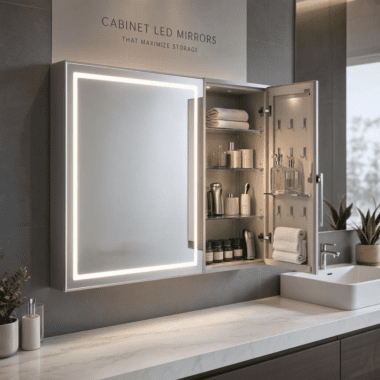
Explore our cabinet LED mirrors for storage-plus-defogger solutions, our smart LED mirrors for touch-sensor control, or our custom-size LED mirrors if you need a non-standard fit. Bulk enquiries and export orders welcome — contact us for spec sheets and volume pricing.